Talk with people in Japan with confidence, from your first The two Japanese sound alphabets, hiragana and katakana. Together with kanji they make up written Japanese. to N1-level Japanese. Real conversations, natural phrases, every answer explained.
What staff will actually say to you, and how to answer.
Short scenes from everyday places. Hear the line, then answer yes or no. Reading help in Japanese written in the Latin alphabet, like “arigatou”. Handy for reading aloud before you learn kana. or The two Japanese sound alphabets, hiragana and katakana. Together with kanji they make up written Japanese.: try both below.
Play the A Japanese convenience store. They’re everywhere, often open 24 hours, and sell meals, drinks and travel tickets. Scene free, then the A casual chain restaurant (famiresu): big picture menus, a call button on the table, open long hours., the clothes shop and hotel check-in.
Reading help:
A Japanese convenience store. They’re everywhere, often open 24 hours, and sell meals, drinks and travel tickets.
Illustration
Staff
「袋はご利用ですか。」Fukuro wa go-riyō desu ka.
“Do you need a bag?”
Your turn
Say yes or no. Flip the card to see both answers, then read one out loud.
Staff asks
“Do you need a bag?”
You say
Yes, pleaseHai, fukuro onegai shimasu.「はい、袋お願いします。」“Yes, a bag please.”
No, thanksFukuro wa daijōbu desu.「袋は大丈夫です。」“No bag, thanks.”
After an offer, 大丈夫です means “No, thanks.”
A casual chain restaurant (famiresu): big picture menus, a call button on the table, open long hours.
Illustration
Staff
「ドリンクバーはお付けしますか。」Dorinku bā wa o-tsuke shimasu ka.
“Would you like to add the A self-serve soft-drink station at family restaurants: pay a small extra charge once, refill as often as you like.?”
Your turn
Say yes or no. Flip the card to see both answers, then read one out loud.
No, thanksDorinku bā wa daijōbu desu.「ドリンクバーは大丈夫です。」“No drink bar, thanks.”
Clothes shop
Illustration
Staff
「プレゼント用にお包みしますか。」Purezento-yō ni o-tsutsumi shimasu ka.
“Shall I gift-wrap it?”
Your turn
Say yes or no. Flip the card to see both answers, then read one out loud.
Staff asks
“Shall I gift-wrap it?”
You say
Yes, pleaseHai, purezento-yō de onegai shimasu.「はい、プレゼント用でお願いします。」“Yes, it’s a present, please.”
No, thanksIe, jitaku-yō desu.「いえ、自宅用です。」“No thanks, it’s for me.”
Hotel check-in
Illustration
Staff
「チェックインでいらっしゃいますか。」Chekku-in de irasshaimasu ka.
“Are you checking in?”
Your turn
Say yes or no. Flip the card to see both answers, then read one out loud.
Staff asks
“Are you checking in?”
You say
Yes, pleaseHai, Sumisu de yoyaku shite imasu.「はい、スミスで予約しています。」“Yes, the booking is under Smith.”
No, thanksIie, chekku-auto desu.「いいえ、チェックアウトです。」“No, I’m checking out.”
Illustrations with example lines, not final app screens.
Travel mode: the right words, right when you need them.
One switch, and Hanamaru becomes your travel companion. Tap where you are, show or play your line in Japanese, and see the staff's answer in English.
Cards for the A rechargeable travel card you tap at station gates and on buses. Many shops and konbini take it too., café, A Japanese convenience store. They’re everywhere, often open 24 hours, and sell meals, drinks and travel tickets., station, restaurant, hotel and shop.
Premade phrases written for Hanamaru. No machine translation.
Preview of travel mode: a grid of situations (IC card, café, konbini, station, restaurant, hotel, shop). One card each for the IC card, the café and the konbini is free.
Every answer explained
Every option has a reason. Every word has a source.
When you get it wrong, you see why. When you get it right, you see why too.
A short reason for every option, not only the right one.
Open dictionary data, credited where you read it.
Original practice questions, written for Hanamaru. JLPT-style, never copied from real exams.
N5-level · ParticlesIllustration
Choose the word that fits.
駅( )行きます。
へ○Correct
へ marks the direction you move toward. “I go to the station.”
を×Your answer · Not quite
を marks what you act on, or a place you move through. Here you need the destination.
の
の links two nouns, as in 駅の名前 (the station’s name).
が
が marks the subject. The station is not the one going.
Illustration of an answered question. Dictionary data: JMdict (EDRDG), CC BY-SA 4.0.
How you learn
One clear path, from kana to N1.
01
Kana first, free
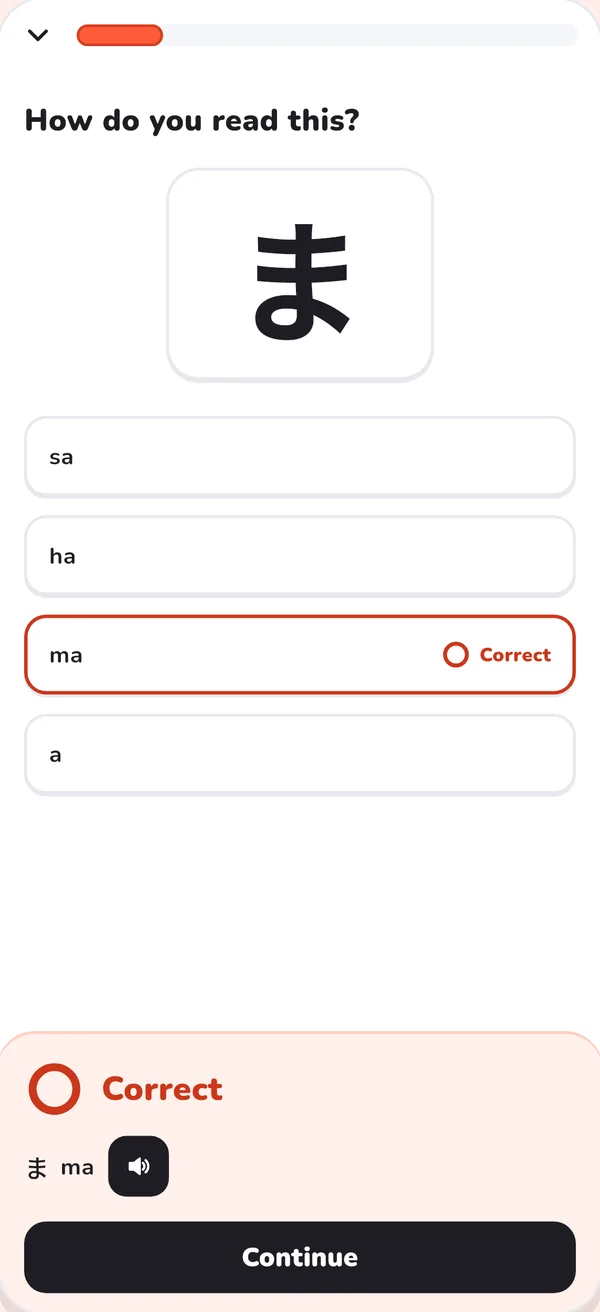
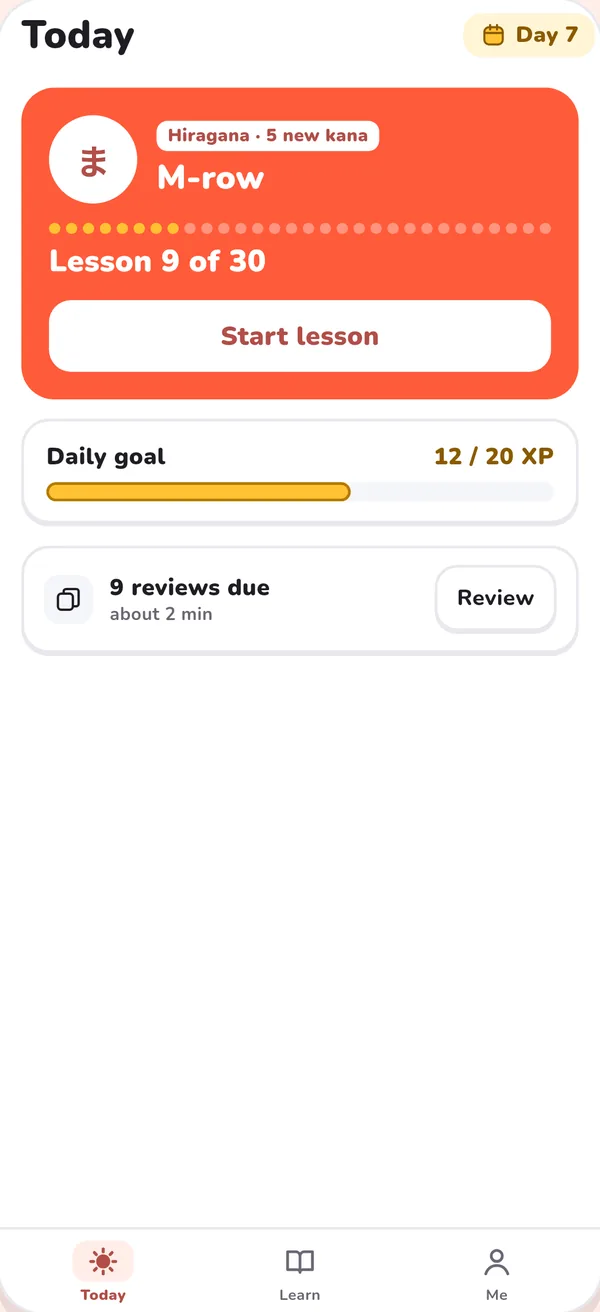
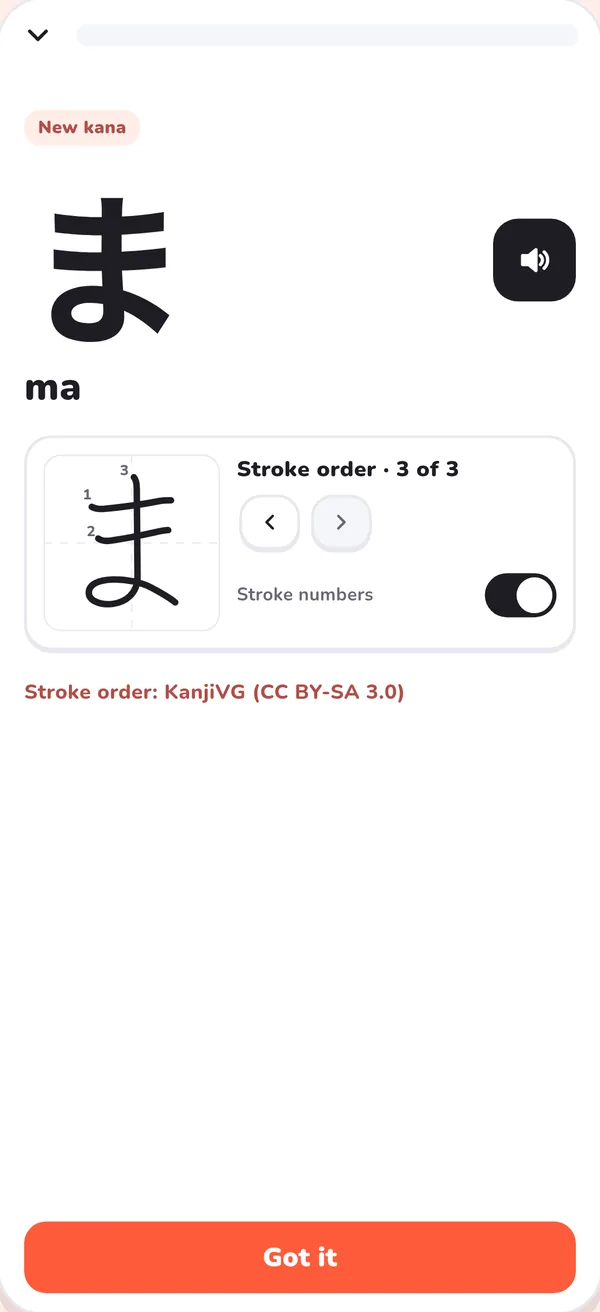
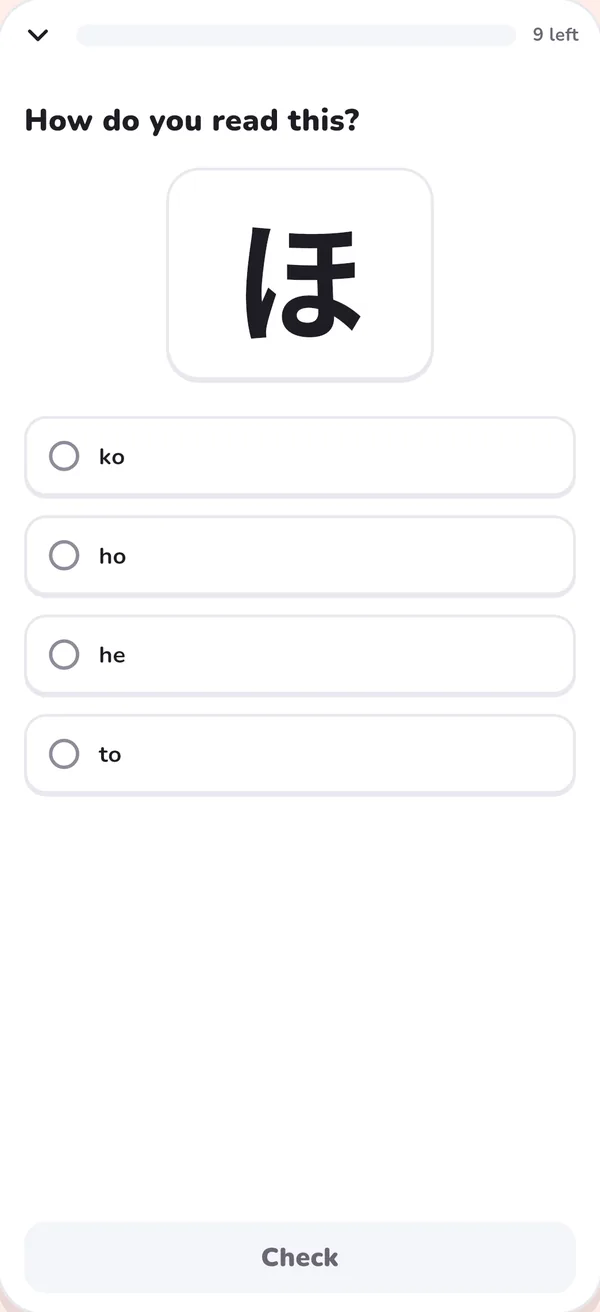
Hiragana and katakana, with stroke order and writing.
02
Lessons from N5 to N1
Short lessons with every exercise type: choose, build sentences, type readings, counters, reading. From N5 all the way to N1.
03
Reviews that remember for you
Spaced repetition (FSRS) brings each word back right before you’d forget it.
04
Real life
Scenes, a dictionary that understands conjugated forms (食べました → 食べる), and reading with furigana and tap-to-look-up.
On Android now
Rather speak than read? Try Everyday.
A second path for people who want to talk with Japanese people now and read later. Every line is in Japanese written in the Latin alphabet, like “arigatou”. Handy for reading aloud before you learn kana. with audio, built from real everyday situations, so you can say it out loud from day one. When you’re ready, it nudges you towards The two Japanese sound alphabets, hiragana and katakana. Together with kanji they make up written Japanese..
Free to try:
Getting your A rechargeable travel card you tap at station gates and on buses. Many shops and konbini take it too. at the airport
At the konbini
Buying a ticket
The rest of the path comes with Hanamaru Plus.
In the app
What’s in the app today.
Kana, the N5 to N1 paths, travel mode and the everyday tools around them. JLPT-style practice, not an official JLPT product.
Kana course
Hiragana and katakana with sound, stroke order and writing. Free.
N5 to N1 paths
Lessons, grammar pages, reading and listening, plus JLPT-style drills and timed mock exams. A placement test starts you at your level.
Word decks and reviews
Ready-made decks for each level, unit and scene, or your own lists. Set how many new cards a day.
Scenes
Pay at a A Japanese convenience store. They’re everywhere, often open 24 hours, and sell meals, drinks and travel tickets., order at a A casual chain restaurant (famiresu): big picture menus, a call button on the table, open long hours., shop for clothes, check in at a hotel: hear what staff say and answer, simply or politely. The konbini Scene is free.
Travel mode
12 two-sided phrase cards for the A rechargeable travel card you tap at station gates and on buses. Many shops and konbini take it too., café, A Japanese convenience store. They’re everywhere, often open 24 hours, and sell meals, drinks and travel tickets., station, restaurant, hotel and shop. Show staff the Japanese side and read their answer in English. Three cards are free.
Dictionary and reading
A Japanese-English dictionary that understands conjugated forms, and a reading library of N5 to N1 passages with furigana and tap-to-look-up.
Mini games
Picture spell, Speed match, Japanese check and Kana of the Day, a daily four-kana word puzzle.
Achievements
Badges for kana, streaks, reviews, lessons, Scenes and games.
Reminders
A daily nudge and a note when reviews are ready, if you want them. Never between 22:00 and 08:00.
Practice your way
Include, ask first or skip speaking, writing, listening and typing in your lessons.
Japan words explained
Tap a word like A Japanese convenience store. They’re everywhere, often open 24 hours, and sell meals, drinks and travel tickets. or A rechargeable travel card you tap at station gates and on buses. Many shops and konbini take it too. for a short explanation, as on this page.
Free samples
Try N5 Unit 1, three grammar points, the konbini Scene, three travel cards and the sample test before you subscribe.
Your decksIllustration
Today18 / 30 cards
N5 · Unit 3: Food and drinkLevel
35 new · 21 learning · 64 learned
Konbini wordsScene
13 new · 9 learning · 12 learned
Verbs I keep missingMy list
4 new · 11 learning · 3 learned
Illustration of the deck list: a daily target of 30 cards, and decks by level, by scene and from your own list, each with new, learning and learned counts.
Flashcard decks, ready when you are.
Pick a ready-made deck and practise it as often as you like, on the same spaced-repetition schedule as the rest of the app. Nothing to set up.
Ready-made decks for every level, unit and scene. Add your own lists only if you want to.
Set a daily target for new cards: 10, 30, 50, 100 or your own number.
See new, learning and learned for every deck.
Speaking practiceIllustration
袋は結構です。
Model
You
Your phone heard:袋は結構です。
Illustration of speaking practice: listen to the model, record yourself, compare the two, and see what your phone heard.
Speak out loud, privately.
Listen and repeat with your phone’s Japanese voice. On Android, record yourself and compare with the model; on iPhone, say the line out loud and mark how it went.
No scores and no judgement.
Always optional: you can skip any time.
Recordings never leave your phone.
Calm by design
One thing on the screen at a time.
An uncluttered screen, clear type and one accent colour. Light or dark, it stays quiet so you can focus.
Learns offline
No ads
No account needed to start
We never sell your data
Free and Plus
Start free. Go further with Plus.
Free
Kana course
€0, always
The full hiragana and katakana course, with sound and stroke order
Free samples: N5 Unit 1, three grammar points, the konbini Scene, three travel cards and the sample test, plus the N5 and N4 kanji decks
The games: Japanese check, Kana of the Day and kana Speed match
Japan-specific words explained
No ads
Plus
Hanamaru Plus
€49.99 a year · or €7.99 a month
The N5 to N1 paths, with word and grammar reviews
Grammar pages, reading and listening
JLPT-style drills and mock exams
Word decks, the dictionary and speaking practice beyond kana
Every Scene and all travel cards
Everything beyond kana. New subscribers start with a 7-day free trial; cancel any time in Google Play or the App Store. Lifetime is a one-time purchase: €74 instead of €149 until 30 November 2026. Hanamaru holiday season: play the hiragana game and earn up to 60% off Plus Monthly (the first 3 months) or Plus Yearly (the first year).
No. It’s original JLPT-style practice written for Hanamaru, not an official JLPT product. Not affiliated with the Japan Foundation or Japan Educational Exchanges and Services. Read the full disclaimer.
The kana course, the games, the N5 and N4 kanji decks and the free samples are free. Everything else is Hanamaru Plus: €49.99 a year or €7.99 a month, with a 7-day free trial for new subscribers. Lifetime is a one-time purchase: €74 instead of €149 until 30 November 2026. Hanamaru holiday season: play the hiragana game and earn up to 60% off Plus Monthly (the first 3 months) or Plus Yearly (the first year).
Does it work offline?
Yes. Lessons, reviews, the dictionary and reading all work without a connection.
Do I have to speak?
No. Speaking practice is optional and you can always skip. Recordings stay on your phone and are never uploaded.
Where does the content come from?
Lessons and questions are written for Hanamaru, never copied from exam papers or textbooks. Words, readings and kanji come from open dictionary data (JMdict, KANJIDIC2, KanjiVG), credited in the app.
Which levels are included?
Hanamaru has kana and the N5, N4, N3, N2 and N1 paths. Levels are N5-level, N4-level and so on: estimates, not official JLPT lists. Not affiliated with the Japan Foundation or Japan Educational Exchanges and Services.
What can I try for free?
The whole kana course, the games (Japanese check, Kana of the Day and kana Speed match), the explanations of Japan-specific words, and free samples: N5 Unit 1, three grammar points, the konbini Scene, three travel cards and the sample test, plus the N5 and N4 kanji decks. Reviews of what you learned in a sample stay free.
Does this website use cookies?
No. This site sets no cookies and runs no analytics. Details are in the privacy policy.
Feel at home in Japan.
Download Hanamaru on the App Store or on Google Play.